AI in a small business in Monaco: four quick wins and the rules to know


What should a business of 1 to 10 people hand to AI first?
Four tasks that use data you already have: sorting incoming email with draft replies, chasing quotes and invoices, extracting documents you receive into a spreadsheet, and the weekly round-up. Each can be set up without changing software, with a person approving before anything is sent. Even under 50 employees, a record of processing is still required for non-occasional processing such as a client file (Law No. 1.565 of 3 December 2024, article 27).1,2
Key points
- In Monaco, the private sector counted 6,378 employers and 6,273 self-employed workers at the end of 2025: the small business is the norm.3
- Small businesses are lagging behind: in France, 15% of those with 10 to 49 employees used AI in 2025, against 58% of those with 250 employees or more.4
- Written text is the place to start: text analysis is the most common use of AI in the Union, and one trial measured two hours less on email per week.5,6
- The Fonds Bleu (Blue Fund) can co-finance a digital project up to 70% of its value excluding tax, with a priority for data integration and AI.7
In a business of a few people, there is no IT department and no assistant for every file. It is often the owner who sorts email in the evening, chases invoices between meetings and prepares Monday's figures. This guide does not repeat the full method: it lists the quick wins that work at this size, what is best kept out of AI's reach at first, and the handful of obligations that apply even to a very small business.
Why small businesses have ground to make up
Monaco's economy is made up of small businesses: at the end of 2025, the private sector had 59,724 employees across 6,378 employers, plus 6,273 self-employed workers.3 We found no public statistics on AI use in Monaco businesses; the closest are French.
In France, AI use rises with company size: 15% of businesses with 10 to 49 employees in 2025, 31% of those with 50 to 249, and 58% above that.4 The survey does not cover businesses with fewer than 10 employees, and no data shows where they stand. In the Union, 20% of businesses with 10 or more employees used AI in 2025.5
Four quick wins, from the simplest to the most involved
What these tasks have in common: they come back every week, follow simple rules and deal with text. That is the most common ground for AI in business, with the analysis of written text topping the list of uses in the Union in 2025.5
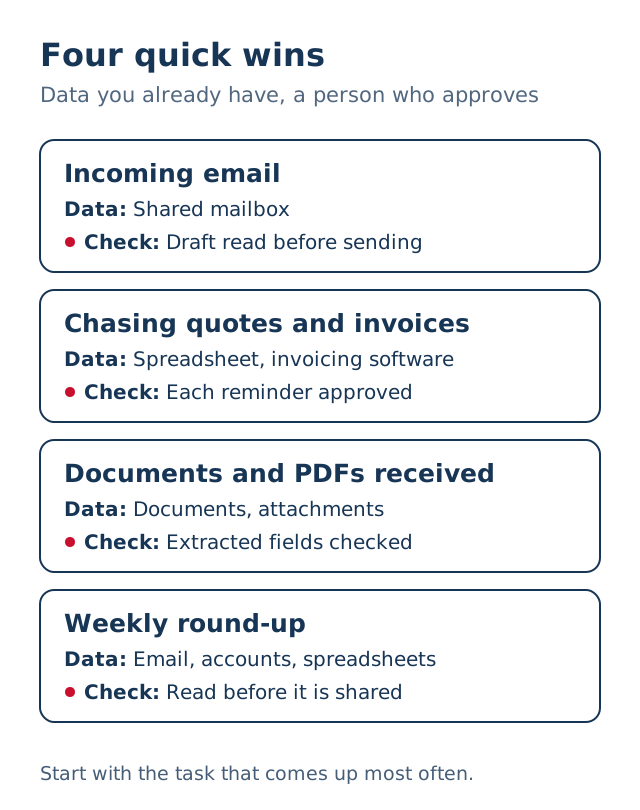
- Incoming email. The agent sorts messages, flags what is urgent and prepares a draft that you read over. In a trial of 7,137 employees at 66 companies, users of an integrated assistant spent two hours less per week on email.6
- Chasing quotes and invoices. It spots what is waiting for an answer or a payment and prepares the reminder with the client's history. You approve every message sent.
- Documents you receive. It files documents and extracts amounts, dates and references from a PDF into your spreadsheet or invoicing software. You check the extracted fields during the first few weeks.
- The weekly round-up. It gathers figures scattered across email, accounts and spreadsheets, then drafts a summary for you to read before sharing it.
Start with the one that comes up most often in your business. For how to measure the gain and then expand, the full method is in AI transition: where to start.
What is best not handed to AI at first
- Decisions that affect a person. Turning down a client, setting an individual price, rejecting a job application: the law forbids basing these solely on automated processing, save for exceptions that require human involvement (article 19).1
- Sensitive data. Health data, criminal records and other sensitive data require a record of processing whatever the size of the business (article 27) and may call for an impact assessment (article 35).1
- Copy and paste into a consumer tool. Every request sent to a model hosted outside the European Union or an adequate country is a transfer; the United States is not on the list of adequate countries, which means safeguards (article 98) or an authorisation (article 100) are required.8,1
- Automatic sending from day one. In a small business, a misfired email is noticed straight away; keep a person approving until the tool has proved itself.
A very small business's obligations, in plain terms
Being small does not exempt you from everything. Here is what Law No. 1.565 expects of a business of 1 to 10 people that connects an AI to its client data.1
- A record for this processing. The exemption for businesses under 50 employees does not apply to non-occasional processing, and the APDP (Monaco data protection authority) cites managing client files (article 27).1,2
- A written contract with the provider. It must offer sufficient guarantees (article 26).1
- Informing your clients. Purposes, legal basis, retention period and recipients, from the moment the data is collected (article 11).1
- No mandatory data protection officer, as a rule. It remains optional, except for large-scale monitoring or large-scale sensitive data (articles 28 and 29).1
- Notification in the event of a breach. To the APDP, without undue delay and where possible within 72 hours (article 32).1
If you sell to clients located in the Union, the GDPR may also apply, with a representative designated in writing (articles 3 and 27 of the GDPR).9 A chatbot open to that public must say it is an AI, under article 50 of the EU AI regulation, applicable since 2 August 2026.10,11 The detail is in our guide AI and personal data in Monaco.
Getting help and funding in Monaco
The Extended Monaco programme for businesses offers a quick questionnaire, "AI OpportunityA", to spot where AI adds value, an online training course in short modules, "AI FlashLearn", and a directory of digital professionals.12,13
Its Fonds Bleu (Blue Fund) co-finances, subject to conditions, digital transformation plans up to 70% of their value excluding tax. Its priorities include data integration and AI, cloud computing projects are excluded, and you should allow about three months from a complete application.7 The page sets neither a minimum company size nor a list of providers: ask the Extended Monaco team before putting the application together. Our article Extended Monaco and AI for businesses explains the programme in detail.
With PRAGMA: a first gain with no commitment
The free AI audit reviews your repetitive tasks and your tools, then a working prototype runs on your own data within 72 hours, with no commitment, subject to eligibility checked on the call. If you are happy with the result, the full version is built with you over a 30 working day development phase, then a dedicated developer keeps it evolving.
European hosting, or hosting in Monaco on request, subject to technical and contractual validation. Processing that involves personal data can be handed only to models served from the European Union with no retention of requests, once the personal data has been pseudonymised.
PRAGMA does not show prices on this site: the quote comes after the prototype. The article how much an AI agent costs in Monaco explains what makes a budget vary, and how to choose an AI agency in Monaco gives the ten questions to ask any provider.
Frequently asked questions
Is my business too small for AI?
No. As soon as a repetitive task takes someone several hours a week, part of it can be handed to an agent, without changing software.
Does a three-person business need to keep a record of processing?
For non-occasional processing, yes: the APDP cites managing client files as an example.2 An AI connected to that file belongs in it (article 27).1
Do we need to change our software or buy licences?
No. The agent connects to your email, your files and the software you already use. The audit lists the connections needed before any work starts.
What does the first step cost?
Nothing: the audit and the prototype on your data within 72 hours are free and come with no commitment, subject to eligibility. The quote comes afterwards, for what you have seen working.
Can public funding pay for the project?
The Fonds Bleu (Blue Fund) co-finances, subject to conditions, up to 70% of the value excluding tax of a digital transformation plan, with AI among its priorities.7 Eligibility is checked with Extended Monaco.
Who controls what the agent sends?
You do. The agent prepares the messages and updates, a person on your team approves them, and every action stays recorded in a log.
To get started, note the task that takes up most of your time each week and describe it in the contact form. We check eligibility for a free prototype during the call, then you decide what comes next.
Request the free audit and prototype
Sources
- Légimonaco, Loi n° 1.565 du 3 décembre 2024 relative à la protection des données personnelles,
- APDP, FAQ,
- IMSEE, The private sector,
- Insee, Les technologies de l’information et de la communication dans les entreprises en 2025, Insee Première n° 2120,
- Eurostat, 20% of EU enterprises use AI technologies,
- NBER, Shifting Work Patterns with Generative AI, working paper 33795,
- Gouvernement Princier, Extended Monaco Entreprises, Funding your project,
- Journal de Monaco, Arrêté Ministériel n° 2026-548 du 30 septembre 2026 fixant la liste des pays, territoires et organisations internationales disposant du niveau de protection adéquat,
- EUR-Lex, Règlement (UE) 2016/679 relatif à la protection des données (RGPD),
- EUR-Lex, Règlement (UE) 2024/1689 établissant des règles harmonisées concernant l’intelligence artificielle,
- EUR-Lex, Regulation (EU) 2026/1744 (Digital Omnibus on AI),
- Gouvernement Princier, Extended Monaco Entreprises, The Extended Monaco programme for businesses: general information,
- Gouvernement Princier, Extended Monaco Entreprises, Find a professional to support you,