How long does an AI project take in Monaco?


How long does an AI project take for a business in Monaco?
With PRAGMA, an AI project moves in three stages. First, a free working prototype in 72 hours that runs on your data, after a free audit and a call that checks your eligibility. Next, a 30 working day build for the complete version. Then a dedicated developer who keeps improving the tool as your team uses it. The pace depends mostly on access to your tools, the state of your data and how clearly the approval rules are set. If you apply to the Fonds Bleu (Blue Fund), allow about 3 months of review from a complete application1.
Key points
- At PRAGMA: a call, a free audit, a working prototype in 72 hours, a quote, 30 working days of build, then a dedicated developer.
- From what we see on our own projects, delays come more often from access, data and approval rules than from the technology.
- Some legal steps may apply depending on the case: an impact assessment for high-risk processing, a written contract with the processor2.
- The Fonds Bleu (Blue Fund) requires a business plan and takes about 3 months from a complete application1.
- Time saved shows over several weeks: record the hours spent before you start.
The question of timing often comes before the question of budget: how many weeks before the team feels a difference? Here is the schedule a project follows at PRAGMA, the outside timelines to plan for, what can slow things down and what you can prepare so the schedule holds.
The timeline of an AI project at PRAGMA
A project does not start with a fifty-page specification. It starts with one precise task, the one that takes up the most of your team's hours, and every stage has a duration known in advance.
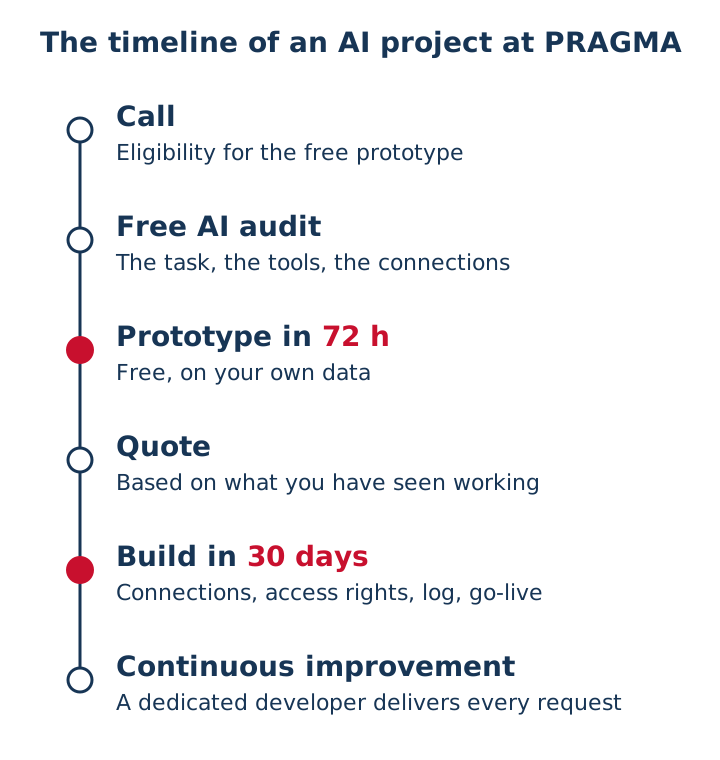
- The call: we talk about the task and your tools, and we check whether your business is eligible for a free prototype.
- The free AI audit: we look at the task with the people who do it, the software involved and the connections needed, before any commercial discussion.
- The prototype in 72 hours: a first version running on your own data, free and with no commitment.
- The quote: it comes after the prototype and covers what you have seen working. What makes it vary is set out in the article how much an AI agent costs in Monaco.
- The 30 working day build: the complete version is built with your team, tested, secured, hosted and put into service.
- Continuous improvement: a dedicated developer stays at your side; you ask for an improvement in one sentence and we deliver it tested.
Why 72 hours is enough for a prototype
The prototype does not try to cover everything. It handles a single task, on real files from your business, to answer one simple question: does AI save time on this particular piece of work? Your team tries it, spots the cases it handles badly and says what is missing.
Starting small also follows a recommendation Anthropic makes to teams building agents: find the simplest solution possible, and add complexity only when it demonstrably improves the outcome3. If the prototype does not convince you, you keep the list of tasks identified during the audit and you pay nothing.
What happens during the 30 working days of build
Once the prototype is approved and the quote accepted, the build takes 30 working days. We start from the team's feedback on the prototype to build the complete version: the permanent connections to your tools, each person's access rights, the log of actions and human approval before anything is sent.
At the end of those 30 working days, the tool is in service and your team uses it every day. The full support we provide is described on the page AI transition for businesses in Monaco.
What slows an AI project down
The announced timelines hold when a few conditions are met. On our projects, when a schedule slips, the cause is most often one of the following, and rarely the technical work itself. This is PRAGMA's own observation, not a statistic.
- Access to tools: an administrator account nobody can find, a software vendor slow to open a connection, a password held by a single person who is away.
- Data quality: duplicate spreadsheets, client files that were never cleaned, scanned documents that first have to be made readable.
- Approval rules: who reviews, who approves, which exceptions are handled separately. Until they are set, the agent cannot apply them.
- Team availability: a prototype that nobody tries produces no feedback, and the build has to wait.
Public statistics point the same way on one count: among French businesses with 10 or more employees that use AI, 53% cited a lack of expertise as an obstacle in 20254. A provider who runs the project brings that expertise; it does not replace the person on your team who knows the task.
Legal steps to plan for, depending on the project
For a business established in Monaco, Law No. 1.565 of 3 December 2024 on the protection of personal data applies, whether the processing takes place in Monaco or elsewhere2. It removes most of the former prior formalities in favour of a principle of accountability5, but some steps take time and should be planned from the audit onwards.
- The impact assessment: mandatory when processing, in particular through the use of new technologies, is likely to result in a high risk, for example an evaluation of people based on profiling (article 35)2.
- The processing contract: processing entrusted to a processor is governed by a written contract (article 26)2.
- The record of processing activities: businesses with fewer than 50 employees are exempt, unless the processing is risky, not occasional or involves sensitive data (article 27)2; the APDP (Monaco data protection authority) cites the management of client files as processing that is not occasional5.
- Informing people: the European AI regulation also applies to a deployer established outside the Union when the output of its system is used in the Union6, and since 2 August 2026 providers of AI systems designed to interact with people must ensure those people know they are dealing with an AI, unless this is obvious (article 50, paragraph 1)6.
Not every project adds all of these steps: the audit tells you which ones apply to yours. The details are in the article AI and personal data in Monaco.
If you apply to the Fonds Bleu (Blue Fund)
The Fonds Bleu (Blue Fund) of the Extended Monaco Enterprises programme co-finances, subject to conditions, digital transformation projects up to 70% of their net value excluding tax1. It runs on its own timetable, which is longer than a prototype.
- The application is filed through the dedicated online service, with the listed documents and a detailed business plan, which is mandatory and follows the template provided1.
- Review generally takes 8 to 10 weeks from a complete and validated application, then about a month for the committee, so about 3 months in total1.
- The official page does not say whether the project can start before the decision, nor whether a project carried out by an outside provider is eligible: put both questions to the programme team on +377 98 98 96 551.
The free prototype can help put figures in the business plan: it gives you hours saved that are measured rather than estimated. The programme's other schemes are covered in the article Extended Monaco Enterprises and AI.
When to measure the gain
Time saved shows over several weeks of real use, not on the first day. In the field experiment run across 66 firms and 7,137 employees, the effect on time spent on email was measured over six months, with results drawn from the second half of the period: two hours less per week for those who used the tool7.
For your project, record the hours spent on the task before you start, then compare after a few weeks in service. The calculation method is in the article on the cost of an AI agent.
What you can prepare before you start
A few days of preparation on your side save weeks of waiting. None of it requires technical skills.
- Describe the task in a few lines: what comes in, what the person does with it, what comes out.
- List the tools that hold its information: email, shared folders, CRM, spreadsheets, WhatsApp.
- Name one person who knows the task well and can test the prototype.
- Identify who can open access to the accounts involved.
- Record the time spent on this task today, in hours per week, so you can measure the gain later.
To choose the task, the article AI transition in a small business: where to start gives you criteria.
Frequently asked questions
Can the prototype be ready in less than 72 hours?
The 72 hours start once access is open and the task is described. What saves the most time is preparation on your side, not squeezing the stages together.
Does the 30 working day build start right after the prototype?
It starts once you have approved the prototype and accepted the quote. In between, you take the time you need to decide, with no commitment.
What happens after the 30 working days?
The tool is in service and keeps evolving. A dedicated developer receives your improvement requests, each put in one sentence, and delivers them tested.
How long does a Fonds Bleu (Blue Fund) application take?
About 3 months from a complete application: 8 to 10 weeks of review, then about a month for the committee1. Check with the programme team whether your project can start before the decision.
Do you need an impact assessment before launching an AI agent?
Only if the processing is likely to result in a high risk for people, within the meaning of article 35 of Law No. 1.5652. The audit checks this for your case.
Does a broader project take longer?
We always start with a single task. The next ones are added one at a time, each with its own prototype, once the first one is running and the team is using it.
To find out the timeline of your own project, describe in the contact form the task that takes up most of your team's time. We check your eligibility for the free prototype on a first call, then the audit sets the stages.
Request the free audit and prototype
Sources
- Gouvernement princier, Mon entreprise à Monaco, Funding your project,
- Legimonaco, Loi n° 1.565 du 3 décembre 2024 relative à la protection des données personnelles,
- Anthropic, Building effective agents,
- Insee, Les technologies de l’information et de la communication dans les entreprises en 2025, Insee Première n° 2120,
- Autorité de protection des données personnelles (APDP), FAQ,
- Journal officiel de l’Union européenne (EUR-Lex), Règlement (UE) 2024/1689 du 13 juin 2024 établissant des règles harmonisées concernant l’intelligence artificielle,
- National Bureau of Economic Research, Shifting Work Patterns with Generative AI, NBER Working Paper 33795,