AI is transforming our productivity. So why are we working even more?


If AI makes us more productive, why aren't we working less?
Because the time saved is rarely given back: it is reinvested. Studies measure real gains on specific tasks, including 15% more customer service requests handled per hour on average,1 but across the Danish labour market AI users save only around 3% of their hours, with no reduction in recorded working time.2 Higher expectations, more deliverables and more interruptions absorb the rest. Freeing up time is an organisational choice, not a property of the tool.
Key points
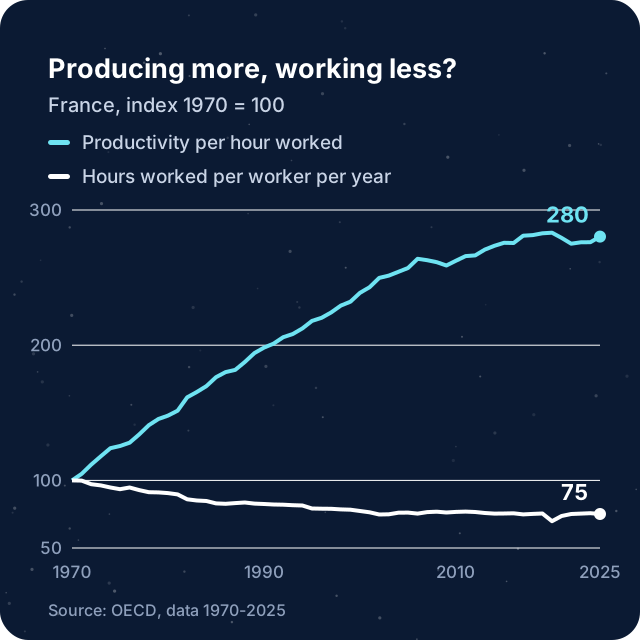
- In 1930, Keynes imagined three-hour working days for our grandchildren.3 In France, productivity per hour has almost tripled since 1970, but hours worked per worker have fallen by only a quarter.4,5
- AI saves time on a task; the company takes it back by asking for more. 77% of AI-using employees surveyed by Upwork say AI has increased their workload.6
- The day is broken into fragments: Microsoft counts an interruption every two minutes during working hours among the most solicited employees.7
- What makes the difference: decide in advance what happens to the time saved, remove tasks instead of speeding them up, and protect blocks of uninterrupted time.
You write an email in ten seconds, a meeting summary writes itself, a spreadsheet fills while you get a coffee. Yet by evening your inbox is still overflowing, messages arrive until 10 p.m. and the week feels more crowded than before. You are not alone in feeling this: economists and organisational researchers have been describing the paradox for more than a century. This article follows their work, source by source, to understand where the time AI saves us goes and how we can get it back.
Keynes's promise: three hours a day
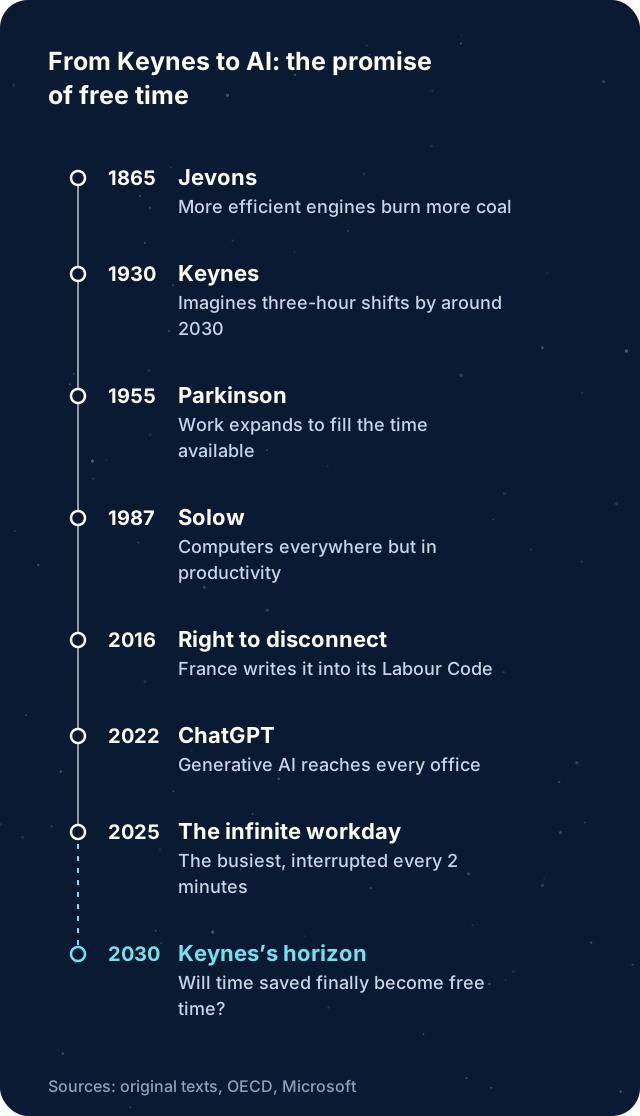
In 1930, in the middle of a crisis, economist John Maynard Keynes published a short, optimistic essay, ‘Economic Possibilities for our Grandchildren’. He predicted that living standards in advanced countries would be four to eight times higher in a hundred years, and that humanity's great challenge would be how to use its leisure. He thought three-hour days, or a fifteen-hour week, would satisfy our old need to work for a long time.3
On wealth, he was broadly right. In France, an hour of work now produces 2.8 times as much as it did in 1970, at constant prices.4 On leisure, much less so: the average French worker worked 1,993 hours in 1970 and 1,498 hours in 2025, a fall of only a quarter.5 That average has also fallen because part-time work has become more common.
In other words, we have largely turned productivity gains into consumption and production, and much less into leisure. Generative AI is entering this long story, not arriving outside it.
Jevons and Parkinson: when efficiency creates more work
In 1865, English economist William Stanley Jevons observed that more coal-efficient steam engines had not reduced coal consumption: they had caused it to soar, because steam became economical for new uses. He argued that it was a mistake to assume that using fuel more efficiently meant consuming less; the opposite could happen.8
Replace coal with an email, a presentation or a report. When a document takes only a minute to produce, we make more of them, make them longer and send them to more people. Someone then has to read, check and comment on every one.
Exactly ninety years later, in 1955, historian Cyril Northcote Parkinson opened an article in The Economist with an observation he considered commonplace, which gave his law its name: work expands to fill the time available for its completion.9 If AI frees up an hour and nobody decides how to use it, that hour fills itself.
What the studies actually measure
AI's gains are not a mirage. At a software company, a conversational assistant helped customer service agents handle an average of 15% more requests per hour, with the least experienced gaining much more than the most experienced.1 In an experiment published in Science, professionals completed writing tasks 40% faster with ChatGPT, with quality rated 18% higher.10
But these gains are measured one task at a time. Across whole economies, the effect becomes modest. A Danish study of 25,000 workers in eleven occupations exposed to AI found that AI users saved around 3% of their hours on average, and no measurable effect on wages or recorded working hours.2 In the United States, a Federal Reserve Bank of St. Louis survey estimates that generative AI users save 5.4% of their working hours, equivalent to 1.4% of the hours of all workers.11
Sometimes the gain is even an illusion. In a controlled METR trial, experienced developers took 19% longer to complete tasks with AI, although afterwards they believed they had been 20% faster.12 In 1987, economist Robert Solow had already captured the problem with computing: the computer age could be seen everywhere except in productivity statistics.13 In France, hourly productivity as measured by the OECD was slightly lower in 2025 than in 2019.4
Four ways the time saved gets eaten up
If task-level gains disappear from the working day, something must be absorbing them. Recent research points to four main mechanisms.
- Expectations rise. 96% of leaders surveyed by the Upwork Research Institute expected AI to improve productivity, but 77% of employees who use it say it has increased their workload, and 47% do not know how to achieve the gains their employer expects.6
- We do more, for longer. An eight-month study at a technology company with about 200 employees, published by Harvard Business Review, found that employees using AI worked faster, voluntarily expanded the scope of their work and spread it across more hours of the day, often without anyone asking them to.14
- The day fragments. Microsoft 365 data shows that the 20% of employees facing the most demands are interrupted by a meeting, email or notification every two minutes during working hours, or 275 times a day.7 Gloria Mark's research shows that people compensate for interruptions by working faster, at the cost of greater stress and pressure.15
- Everything needs checking and coordination. Generated text must be reread, a figure checked, an answer approved. This invisible work grows as output increases, and often falls to the most experienced people.
Add to this an often improvised approach: in 2024, 75% of knowledge workers were already using generative AI, and 78% of them brought their own tools to work without a framework set by their company.16 Without shared rules, everyone saves time individually, while the organisation never sees the benefit.
Turning time saved into time freed
The good news is that none of this is a technical inevitability. It comes down to decisions, and some organisations have already made them.
In the United Kingdom, 61 companies and nearly 2,900 employees trialled a four-day week without a pay cut from June to December 2022. At the end, 56 companies continued, 18 of them permanently; revenue had remained stable (+1.4% on average) and 71% of employees reported less burnout.17 In France, the law of 8 August 2016 established the right to disconnect, requiring the companies concerned to negotiate the use of digital tools outside working hours.18
- Decide before automating. For every task given to AI, decide what happens to the time saved: some to serve clients better, some given back to the team. Without a rule, Parkinson's law takes over.
- Remove rather than accelerate. A report nobody reads does not need to be generated faster: it needs to go. Lasting gains come from tasks removed from the day altogether.
- Measure outcomes, not volume. Counting emails sent or documents produced encourages more of the same. Measure cases closed, response times and hours actually given back.
- Protect attention. Group notifications, set aside meeting-free blocks and reduce the number of channels. Every interruption avoided is worth more than an email written faster.
In Monaco, teams on a human scale
In the Principality, the statutory working week remains 39 hours.19 In a small organisation, the leader knows every role, and that is an advantage. Where a large group may take months to change a rule, a small business can decide in one meeting that the hour AI saves each day on sorting emails will be given back on Friday afternoon, or devoted to clients who deserve it.
This is also where the question becomes most tangible. In a team of five, one hour freed per person each day represents more than a part-time position, provided it is not immediately filled with new tasks.
What we do at PRAGMA
When we work with a company, we start by listing tasks that could disappear before those that could be accelerated. From the outset, we decide with the leader what will happen to the time saved, and measure it with the team once the tool is in place. A person always approves anything sent to a client, so checking stays simple and does not become a hidden burden.
If you want to know where your team loses time, our free AI audit starts with your actual working days. For the step-by-step method, also read where a small business should start its AI transition.
Frequently asked questions
Did Keynes really predict a 15-hour week?
Yes. In ‘Economic Possibilities for our Grandchildren’ (1930), he wrote that three-hour days, or a fifteen-hour week, could put off the problem of free time for a long while, roughly a hundred years into the future.
Does AI really save time?
On specific tasks, yes: 15% higher productivity on average in customer service and 40% less time on writing tasks. Among users, measured time savings are around 3 to 5% of hours (1.4% for all US workers), and have not reduced recorded working time.
What is the Jevons paradox?
It is William Stanley Jevons's 1865 observation that when a resource is used more efficiently, people use it more, so total consumption rises. Applied to work, a document that is easier to produce gets produced in greater numbers.
Does the four-day week work?
In the 2022 UK trial, 56 of the 61 participating companies continued, with broadly stable revenue and less burnout reported by employees. The result depends on preparation: the organisation of work changes before the calendar does.
How can a small business turn time saved into free time?
By deciding in advance how saved time will be used, removing unnecessary tasks instead of speeding them up, measuring outcomes rather than volume, and protecting blocks without notifications or meetings.
Do your tools seem to save you time that you never actually get back? Tell us about your working days in the contact form: we will look with you at what can disappear before talking about AI.
Request the free audit and prototype
Sources
- Brynjolfsson, Li et Raymond, The Quarterly Journal of Economics, Generative AI at Work,
- Humlum et Vestergaard, NBER, Large Language Models, Small Labor Market Effects (working paper 33777, version de mai 2025),
- John Maynard Keynes, Economic Possibilities for our Grandchildren (Essays in Persuasion),
- OCDE, Productivity database, GDP per hour worked, France, prix constants,
- OCDE, Average annual hours actually worked per worker, France, 1970 à 2025,
- Upwork Research Institute, From Burnout to Balance: AI-Enhanced Work Models,
- Microsoft, Breaking Down the Infinite Workday (Work Trend Index special report),
- William Stanley Jevons (Yale, Energy History), The Coal Question, chapitre VII, Of the Economy of Fuel,
- The Economist, Parkinson’s Law,
- Noy et Zhang, Science, Experimental evidence on the productivity effects of generative artificial intelligence,
- Federal Reserve Bank of St. Louis, The Impact of Generative AI on Work Productivity,
- METR, Measuring the Impact of Early-2025 AI on Experienced Open-Source Developer Productivity,
- Robert M. Solow, The New York Times Book Review, We’d Better Watch Out,
- Aruna Ranganathan et Xingqi Maggie Ye, Harvard Business Review, AI Doesn’t Reduce Work, It Intensifies It,
- Gloria Mark, Daniela Gudith et Ulrich Klocke, CHI 2008, The Cost of Interrupted Work: More Speed and Stress,
- Microsoft et LinkedIn, 2024 Work Trend Index: AI at Work Is Here. Now Comes the Hard Part,
- Autonomy, 4 Day Week Global, Université de Cambridge, Boston College, The results are in: the UK’s four-day week pilot,
- Légifrance, Loi n° 2016-1088 du 8 août 2016, article 55 (droit à la déconnexion),
- Legimonaco, Ordonnance-loi n° 677 du 2 décembre 1959 sur la durée du travail,