AI in Monaco real estate: uses, rules and limits


How can a Monaco real estate agency use AI?
A real estate agency can give AI the preparation, never the decision: qualifying an enquiry received in English or Russian, drafting a description from the property sheet, checking that a mandate carries its required terms, summarising a viewing, gathering the documents of a client file. The negotiator approves, the compliance officer decides. In a market of 493 transactions worth 5.9 billion euros in 2025,1 every enquiry matters, and sales agencies remain bound by the due diligence duties of Law No. 1.362.2
Key points
- In 2025 Monaco recorded 493 property transactions worth 5.9 billion euros; the 429 resales reached a record 3.2 billion euros, at 7.6 million euros on average.1
- An agency works under an administrative authorisation, and the mandate it draws up must be in writing and limited in time.3
- For sales, and for lettings from 10,000 euros of monthly rent, the agency identifies its client and the beneficial owner and keeps the documents for five years.2,4
- A decision that significantly affects a person cannot rest solely on automated processing, save for the exceptions set by Law No. 1.565.5
- The EU AI Act applies to a Monaco company as soon as the output of its AI system is used in the Union.6
This guide is written for the Principality’s sales agencies, property managers and developers. It starts from the official market figures and from the texts published on Légimonaco and EUR-Lex, then describes, task by task, what an AI agent can prepare and what the professional keeps. Each use is a possibility to test on your own files, never a promised result.
A market of few transactions, each of very high value
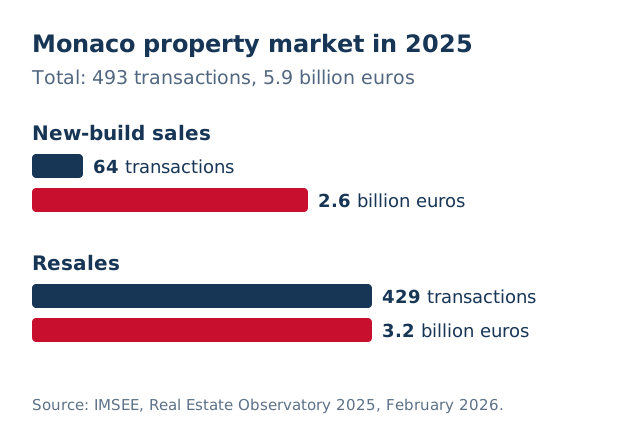
IMSEE’s Real Estate Observatory, built on data from the Mortgage Division of the Tax Services Department, counts 493 transactions in 2025, up 5.8%, for a total of 5.9 billion euros, level with the previous year’s record.1
The two markets moved in opposite directions. Sales of new homes fell to 64 transactions worth 2.6 billion euros, and half of them were concluded at 21.2 million euros or more. Resales rose 17.5% to 429 transactions and 49.1% in value, to a record 3.2 billion euros. The average resale price rose 26.8% to 7.6 million euros.1
The price per square metre is now estimated with a regression model covering both sales and resales: 57,569 euros in 2025, and over 70,000 euros in Larvotto. IMSEE notes that this change of method rules out any comparison with the per square metre prices of its earlier observatories.1
A few hundred deals a year, each worth millions: in the projects we see, an agency’s value lies in the quality of every exchange far more than in volume. That is exactly where an AI agent helps, by preparing quickly and cleanly what the negotiator then reviews.
Qualifying buyer and tenant enquiries in their own language
An enquiry comes in through the website, a portal, email or WhatsApp, often in English, Italian or Russian, sometimes at midnight. Analysing written text is in fact the most common use of AI among European businesses: 11.8% of them did so in 2025, and 20.0% of enterprises with 10 or more employees used at least one AI technology.7
- Reading and record. The agent picks out the project (buying or renting), budget, district, size, timing and language, then fills in the contact record in the CRM.
- Matching. It suggests the listings that fit and flags those that come close. The negotiator chooses what to present.
- Draft reply. It writes a first message in the prospect’s language, which the negotiator adjusts and sends.
- Priority. It sorts enquiries by urgency and completeness, so the team calls back the most advanced projects first.
If an assistant answers visitors on its own and the AI Act applies, it must tell them they are dealing with an AI system, unless that is obvious.6 These transparency duties have applied since 2 August 2026.6
Listing descriptions and mandates
From the property sheet, the agent drafts the description in French, English, Italian and Russian, in the agency’s tone. A person checks every detail: size, floor, service charges, availability. A mistake in a listing binds the agency, not the tool.
The mandate follows precise rules. Anyone who habitually carries out operations on other people’s property, buying, selling, letting or managing it, needs an administrative authorisation.3 At the client’s request, the agency draws up a mandate in writing and limited in time; it sets out the conditions under which the agency may receive funds, how accounts are rendered for management, the fee and which party pays it.3 A promise or agreement with no time limit on its effects is void, and every payment gives rise to a receipt.3
- Completeness check. Before signature, the agent checks that the draft mandate states a term, the fee and the party paying it, and flags what is missing.
- Calendar. It extracts the end dates of current mandates and prepares the list of those to renew or close.
- Account statements. For lettings management, it prepares the owner’s statement from the payments received, which the property manager checks before sending.
The agent does not write the contract in the lawyer’s place: it checks that an approved template has been filled in, and says so when it has not.
Viewings, follow-up and the owner relationship
After a viewing, the negotiator dictates or types a few lines. The agent turns them into a structured report, a follow-up to the visitor in their language and the update owed to the owner. The negotiator reads all three and chooses what goes out.
An NBER field experiment across 66 firms and 7,137 knowledge workers gives a cautious order of magnitude: workers who used a generative AI tool built into their email, meeting and writing applications spent two fewer hours a week on email in the second half of the trial, with no measured shift in the nature of their tasks.8 It is an average across office jobs, not a promise for an agency; it shows where to look for the time saved.
AML files: AI prepares, the professional decides
Monaco’s anti money laundering law, Law No. 1.362, covers the professions of Law No. 1.252 for their property and business sale activities, including letting intermediation when the monthly rent reaches the threshold set by sovereign ordinance, as well as property dealers.2 That threshold is 10,000 euros a month.4
Before entering into a business relationship or assisting a client with a transaction, the agency identifies the client, their representative and, where relevant, the beneficial owner, and verifies these details against a reliable document bearing their photograph.2 It classifies its risks by criteria including clients, countries and the country of origin or destination of funds, applies enhanced due diligence to politically exposed persons, keeps the documents for five years after the relationship ends, and reports any suspicion in writing to the financial intelligence service of the Monaco Financial Security Authority (AMSF) before the operation is carried out.2
- Document list. Depending on the type of client, individual, company or trust, the agent lists the documents expected and drafts the request to the client.
- Formal checks. It checks validity dates and the consistency of names and addresses across documents, and flags every discrepancy.
- File ready for review. It assembles the file in the order the compliance officer expects, with the source of each piece of information.
- Retention. It files the documents with their retention end date, five years after the relationship ends.
What the agent does not do: accept a client, classify a person as politically exposed or decide to file a suspicious transaction report. Law No. 1.565 gives everyone the right not to be subject to a decision producing legal effects or significantly affecting them, based solely on automated processing, including profiling.5 A systematic and extensive evaluation of personal aspects on which such decisions are based also calls for a prior impact assessment.5 The same logic applies in private banking: see AI in private banking and wealth management in Monaco.
Personal data, GDPR and the AI Act: what applies to a Monaco agency
Law No. 1.565 applies to any controller established in Monaco, whether or not the processing takes place in the Principality.5 It names pseudonymisation and encryption among the expected security measures.5 Our guide AI and personal data in Monaco sets out these duties.
Monaco is not an EU member, yet two European texts can apply to a Monaco agency. The GDPR covers a controller not established in the Union when it offers goods or services to people who are there, or monitors their behaviour in the Union.9 Regulation (EU) 2024/1689 on AI covers providers and deployers established in a third country when the output of their AI system is used in the Union.6
As amended by Regulation (EU) 2026/1744, it now asks deployers to support the AI literacy of their staff, without requiring a guaranteed level for each person.10 It classes as high risk the systems intended to evaluate the creditworthiness of natural persons, fraud detection excepted;6 these rules will apply from 2 December 2027.10 A tool that would score a prospective tenant’s creditworthiness therefore deserves a legal review before any trial; sorting and preparing the documents of a rental file is not scoring.
Where to start in an agency
The best first use is a frequent task, easy for a person to check, that already lives in your tools: qualifying incoming enquiries or writing viewing reports, rather than compliance. In the projects we see, an agency quickly learns what an agent does well on a low-stakes task, then extends it.
In the projects we see, the clienteles of real estate, private banking and luxury retail often overlap, and the same principles hold in luxury retail. Our page Real estate CRM and AI agents in Monaco shows how these tasks fit into a single tool.
Data stays on European hosting, or on hosting in Monaco on request, subject to technical and contractual validation. To place real estate among the Principality’s other sectors, see AI use cases for Monaco businesses, sector by sector.
Frequently asked questions
Can AI publish our listings on its own?
It can draft the description in several languages from the property sheet. A person checks every detail before publication, because the listing binds the agency.
Can an AI agent do our KYC checks for us?
No. It can list the documents, check dates and inconsistencies and assemble the file. Identification, enhanced due diligence and suspicious transaction reporting remain the professional’s duties under Law No. 1.362.2
Must we tell a prospect they are talking to an AI?
Where the AI Act applies, a person interacting with an AI system must be told so, unless it is obvious.6 We recommend it in every case: a high-end property client expects to know who they are dealing with.
Can AI screen rental applicants?
It can check that a file is complete. A creditworthiness score for a natural person, however, falls in a category the EU regulation classes as high risk,6 and a significant decision cannot rest solely on automated processing, save for the exceptions set by Law No. 1.565.5
Tell us which task takes your agency the most time: enquiries, listings, mandates or client files. Our free AI audit shows you what an agent can prepare from it, on your data, with no commitment.
Request the free audit and prototype
Sources
- IMSEE, Observatoire de l’Immobilier 2025,
- Légimonaco, Loi n° 1.362 du 3 août 2009 relative à la lutte contre le blanchiment de capitaux, le financement du terrorisme et de la prolifération des armes de destruction massive et la corruption (texte consolidé),
- Légimonaco, Loi n° 1.252 du 12 juillet 2002 sur les conditions d’exercice des activités relatives à certaines opérations portant sur les immeubles et les fonds de commerce,
- Légimonaco, Ordonnance Souveraine n° 2.318 du 3 août 2009 fixant les conditions d’application de la loi n° 1.362 (texte consolidé, article 64),
- Légimonaco, Loi n° 1.565 du 3 décembre 2024 relative à la protection des données personnelles,
- EUR-Lex, Règlement (UE) 2024/1689 établissant des règles harmonisées concernant l’intelligence artificielle,
- Eurostat, 20% of EU enterprises use AI technologies,
- NBER, Shifting Work Patterns with Generative AI, Working Paper 33795 (Dillon, Jaffe, Immorlica, Stanton),
- EUR-Lex, Règlement (UE) 2016/679 relatif à la protection des données (RGPD), article 3,
- EUR-Lex, Regulation (EU) 2026/1744 amending Regulation (EU) 2024/1689 (Digital Omnibus on AI),