Is AI making us stupid?


Does AI make employees less competent?
There is no evidence here that AI makes us less intelligent. But it can hinder learning when it takes over a skill we still need to use on our own. In one maths experiment, AI tutoring with hints avoided the drop seen with an unrestricted assistant.1
Key points
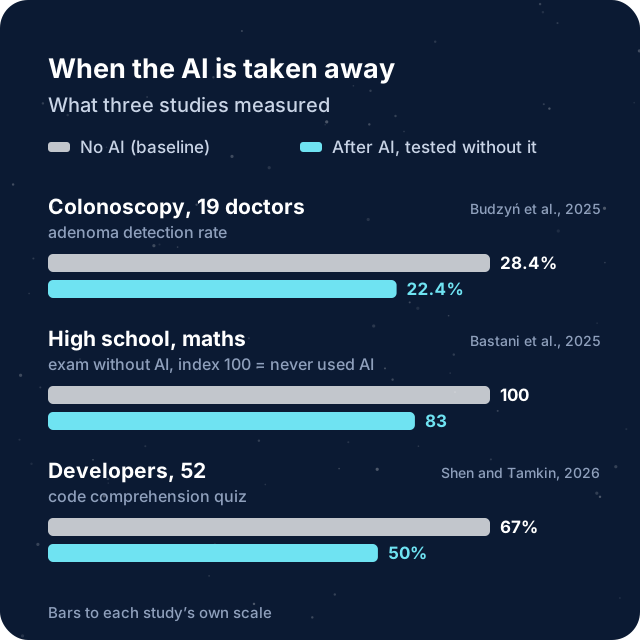
- When AI is taken away, measurable declines appear: detection falling from 28.4% to 22.4% among endoscopists,2 and exam scores 17% lower for high school students.1
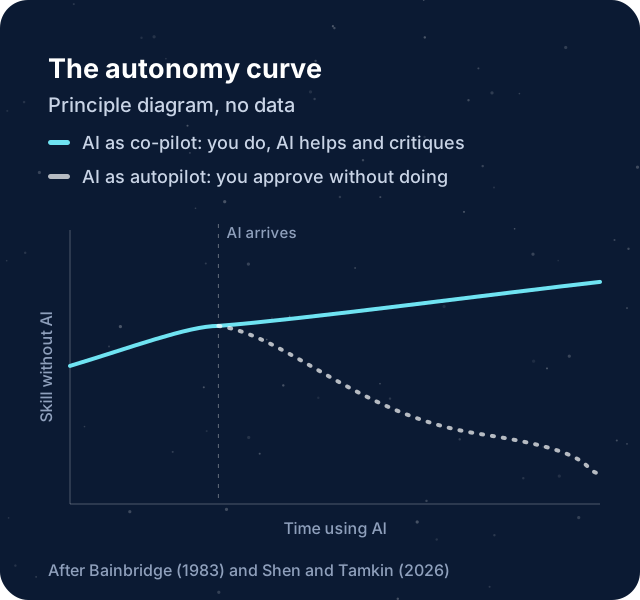
- The risk has been known since 1983: the more we automate, the more skilled the human must be on the day the machine fails, and the less practice they have had.3
- The remedy comes down to a few rules: choose what you hand over, do before you ask, review with a real power to say no, keep time without AI and measure skills.
An email goes out in thirty seconds. Without the assistant, could you still write it and defend what it says? That’s the test I care about: what a team can still do when it closes the tool.
A fear 2,400 years old
In Plato’s Phaedrus, King Thamus worries that writing will let people neglect their memories.4 Writing a list saves us the effort of remembering it: that’s cognitive offloading.5 With AI, we can also hand over writing and reasoning. What we stop practising has changed.
What the studies on critical thinking measure
In a survey of 319 professionals, those who trusted AI the most reported doing less critical thinking. When they did think critically, more of the work went into checking and incorporating answers. That’s a self-report, not a test of their skills.6
When AI is taken away: deskilling, measured
In Poland, adenoma detection in colonoscopies performed without AI fell from 28.4% to 22.4% after an AI tool was introduced. This was an observational study, so it cannot show that the tool caused the drop.2
At a Turkish high school, students who had used unrestricted GPT-4 scored 17% lower on an unaided exam than those who had never had access. There was no measurable drop in the group that got hints rather than answers.1
In a coding experiment, developers who had AI assistance scored 50% on a later unaided quiz, versus 67% for the others. The gap was widest in debugging.7
The automation paradox, known since 1983
In 1983, Lisanne Bainbridge pointed out the paradox: the more routine work a machine does, the less practice people get. Yet they’re the ones expected to take over in difficult cases.3
After the crash of flight AF 447, France’s BEA recommended regular practice in manual handling at high altitude. There’s a straightforward parallel at work: don’t wait for a breakdown or an error to practise without AI.8
The jagged frontier: when AI is confidently wrong
In an experiment involving 758 consultants, GPT-4 sped up tasks within its reach. On a problem chosen to be beyond it, the assisted group found the right answer 19 percentage points less often. A confident answer still needs checking.9
Stupid, no. Dependent, sometimes
A maths exam or a coding quiz doesn’t measure general intelligence. It asks a more useful question: what do we still want to be able to do unaided?
Keeping people at the centre: the method in six rules
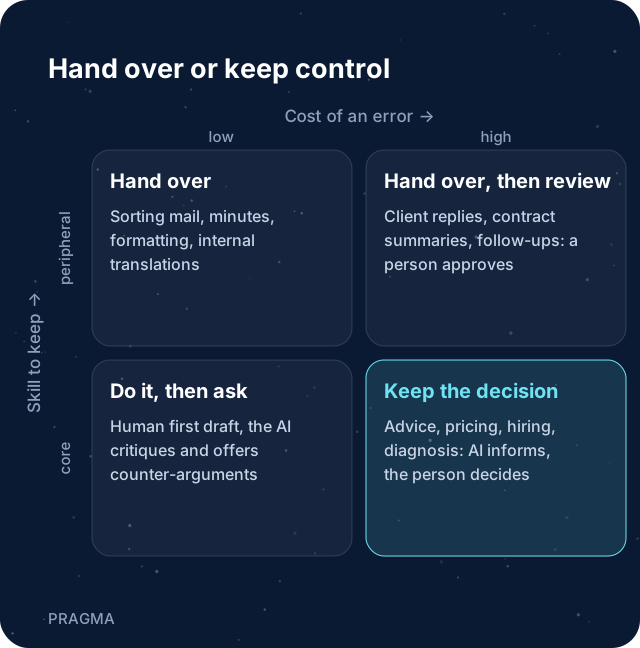
- Choose what to delegate. Sorting email can go to AI; the hiring decision stays with a person.
- Do first, then ask. On core work, make a first attempt and ask AI to challenge it.
- Make it possible to say no. The reviewer needs the time, skill and authority to refuse.
- Practise without AI. Rehearse the work you can’t afford to forget how to do.
- Teach people to check. Show errors from their own line of work and how to spot them.
- Measure. Repeat a real case without the assistant. If quality drops, bring back practice.
To start in the right order, our guide AI transition: where to start sets out the first steps, and the article AI agent or chatbot explains why a well-designed agent prepares the work without deciding for you.
And if you wonder why the time AI saves so often turns into more work, read our article on why we work more when AI makes us more productive.
What the law says: the AI Act and human oversight
The AI Act provides for human oversight of high-risk systems, including some hiring tools. It can also cover a Monaco business when the system’s outputs are used in the EU.10
In Monaco, Article 19 of Law No. 1.565 protects people, subject to exceptions, from solely automated decisions with legal or similarly significant effects.11
In Monaco: small teams, valuable know-how
In a small business, know-how often rests on a handful of people: the account manager who knows every file, the adviser with a feel for the client, the assistant who knows where everything is. That is exactly the capital to protect when rolling out AI. Our article on AI and personal data in Monaco covers the other side: the information you entrust to these tools.
Frequently asked questions
What is automation bias?
Automation bias means following the machine even when it is wrong. It affects experts too, and training alone isn’t enough to prevent it.12
Should junior staff be banned from using AI?
No, but their use should be guided. In the studies, it is the uses where AI does the work in the person's place that hold back learning; when it acts as a tutor or answers conceptual questions, skills build much better.1,7
How can I tell if my team is losing autonomy?
Every so often, redo a real case without AI and compare the quality and the time spent. Watch for weak signals too: approvals given faster and faster, AI errors spotted by clients rather than by the team, people unable to explain a document they sent.
Before automating a task, ask who will still know how to do it when the tool is unavailable. That’s where our free AI audit starts.
Request the free audit and prototype
Sources
- PNAS, Bastani et al., Generative AI without guardrails can harm learning,
- The Lancet Gastroenterology & Hepatology, Budzyń et al., Endoscopist deskilling risk after exposure to artificial intelligence in colonoscopy,
- Automatica, Bainbridge, Ironies of Automation,
- Platon, trad. Léon Robin (Wikisource), Phèdre, 274c-275b,
- Trends in Cognitive Sciences, Risko et Gilbert, Cognitive Offloading,
- ACM CHI 2025, Microsoft Research et Carnegie Mellon, Lee et al., The Impact of Generative AI on Critical Thinking,
- arXiv, Shen et Tamkin, How AI Impacts Skill Formation,
- BEA, Rapport final, accident du vol AF 447 du 1er juin 2009,
- Harvard Business School, Dell’Acqua et al., Navigating the Jagged Technological Frontier, Working Paper 24-013,
- Journal officiel de l’Union européenne, Règlement (UE) 2024/1689 sur l’intelligence artificielle, articles 2, 14 et 26,
- Légimonaco, Loi n° 1.565 du 3 décembre 2024 relative à la protection des données personnelles, article 19,
- Human Factors, Parasuraman et Manzey, Complacency and Bias in Human Use of Automation,