Shadow AI: your teams already use AI, talk about it with them


What is Shadow AI, and what should a company do about it?
Shadow AI is using AI at work without saying so, or without going through the tools the company has chosen. Banning it solves nothing: the first step, heard at the Bernardins, is to talk about it together, regularly.1
Key points
- Shadow AI is using AI at work without saying so, or without going through the tools the company has chosen.
- In 2024, 78% of the people who use AI at work brought their own tools, according to Microsoft and LinkedIn (31,000 people surveyed in 31 countries).1
- Banning it solves nothing. The first step, heard at the Bernardins, is to talk about it together, regularly.
- The right place to talk about it is each profession: accounting, customer service, sales.
- In a Monaco company: one chosen tool, one clear rule on data, one hour a month to say what works and what chafes.
78% of AI users at work bring their own tools. What I heard at the Bernardins, and what I advise in Monaco. The speakers spoke French: their words below are translated from French.
A minute that stayed with me
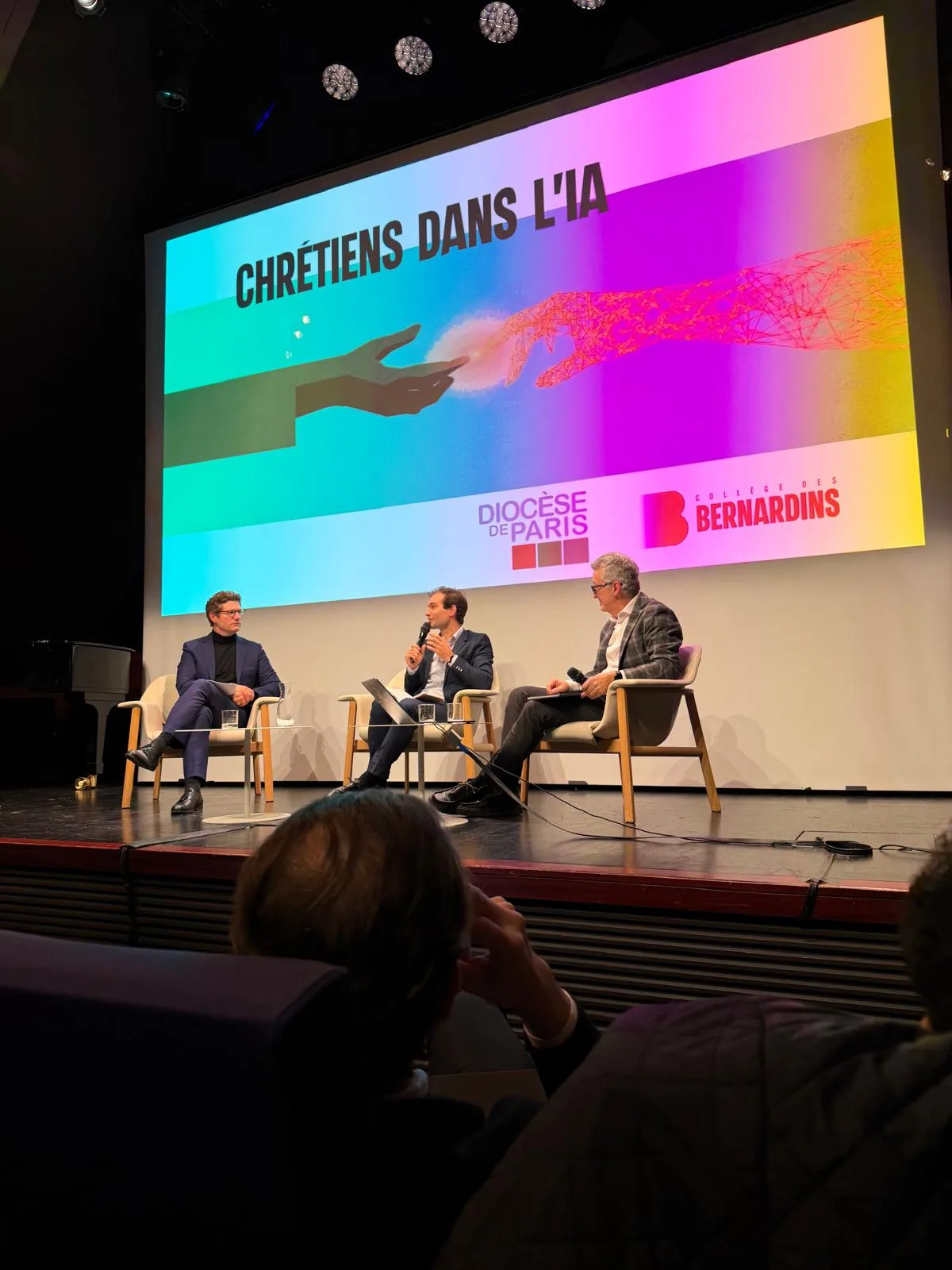
On 19 November I was at the Collège des Bernardins in Paris for the first evening of “Chrétiens dans l’IA” (“Christians in AI”), a series of meetings launched by Pastor Éric Célérier under the patronage of the Diocese of Paris.2 I have already written an article on Leo XIV’s encyclical and business from it. But it is the very last minute of the evening that stayed with me.
Augustin, one of the two guests, is asked for a closing word. He co-founded a jobs platform for students, then a few months ago took over as head of a post-secondary school in Marseille. His answer fits in one sentence: “We talk a lot about Shadow AI, the fact that many people use AI without talking about it. In fact, the first step to start answering that is to deal with it collectively.”3
He adds: “Even if there is no path, even if it is not something guided, at the very least, put the subject on the table, get together regularly.” With tools that improve every six months, the questions will multiply. “We need places to talk about it among humans.”
What the numbers say
This is not an impression. In their May 2024 study, Microsoft and LinkedIn surveyed 31,000 people in 31 countries. The result: 78% of those who use AI at work bring their own tools. Microsoft calls this “Bring Your Own AI” and notes that the company loses the benefits of organised use and puts its data at risk.1 The same study explains why: 60% of the leaders surveyed say their company has no vision or plan to put AI in place.1 Employees do not wait: they start on their own.
Augustin saw it up close. On his platform, algorithms spread the missions among the young people, which already raised questions of bias. Then came ChatGPT: “I got so many questions from these young people about the future of their jobs since ChatGPT that I was a bit lost.” When nobody answers these questions, everyone answers alone, in silence. That is exactly what Shadow AI is.
The right place is each profession
Gonzague, head of digital transformation at the LVMH group, extended Augustin’s answer. For him, almost every profession is going to change, and the question is where these discussions will take place, “within each profession, each trade, so that everyone can try to picture the future of their own job”.
He put it very simply: everyone should be able to say “I am an accountant, I am in customer service, I am in marketing, the future of my job with AI will be this, and so these are the skills I am going to develop”. Earlier in the evening, he described what he had said at noon that very day to his customer service team, whose job is changing radically: “I am going to be here beside you, listening to you, we will experiment together, […] and from there we will choose our rules.”
Augustin gave the format, and I find it right. Come with your uses, “look, I do this, it’s cool”, and also with what bothers you: “here, I have something, it chafes”. Then think it through together.
Why it is even more sensitive in Monaco
In Monaco, many professions live on trust: private banking, wealth management, real estate, hospitality, yachting. The real risk of Shadow AI is a client’s name, an amount or an identity document pasted into a public tool whose settings nobody has checked. This is personal data, which Monegasque law protects: I explain it in our article on Law no. 1.565 and the GDPR and in the one on AI and personal data.
A ban only pushes the use a little further into the shadows. What protects is that the team knows what can leave, what never leaves, and with which tool.
What I advise, and what we do at PRAGMA
- List, without judging, what each person already uses and what for.
- Choose one tool for the team, set up not to keep your data, rather than ten personal accounts.
- Write a short rule: what never goes into an AI tool (client names, amounts, identity documents).
- One hour a month, per profession: what works, what chafes. What works becomes a shared practice.
- Train the team on these uses, which the AI Act also asks of the companies it covers (our article on training teams).
At our place, AI is part of every working day, which is why we talk about it openly among ourselves: what works becomes our way of doing things, what chafes is discussed before going further. If you want an outside view to make that first list, that is the purpose of our free AI audit.
Frequently asked questions
What is Shadow AI?
It is the use of AI tools at work without the company knowing about it or having organised it: a personal ChatGPT account, a browser extension, a transcription app.
Should ChatGPT be banned at the office?
A ban does not remove the use, it hides it. It is better to choose a tool, settle the data question and talk about it regularly as a team.
Where to start in a small team?
With a one-hour meeting: everyone shows what they use and what bothers them. The data rule and the choice of tool come next.
The “Chrétiens dans l’IA” series continues in 2027. I will be back, Plaud in my pocket.
Request the free audit and prototype
Sources
- Microsoft et LinkedIn, 2024 Work Trend Index : AI at work is here. Now comes the hard part,
- Diocèse de Paris, Chrétiens dans l’IA, Collège des Bernardins,
- PRAGMA, Enregistrement de la soirée par l’auteur,