Magnifica Humanitas: what the Pope brings to the AI transition of businesses


After a photo by Edgar Beltrán, The Pillar, CC BY-SA 4.0, via Wikimedia Commons
What does Magnifica Humanitas say to businesses moving to AI?
Signed by Leo XIV on 15 May 2026, the encyclical asks us “to design systems that are centered on the human person and not solely on performance” (n. 150), to know at every stage who answers for a decision taken with AI (n. 105), and to accompany every automation with “verifiable measures” for the employment, retraining and participation of workers (n. 156)1.
Key points
- Magnifica Humanitas is Leo XIV’s first encyclical, dated 15 May 2026: 245 paragraphs on the human person in the time of AI1.
- Its central choice is not “for or against technology”, but constructing Babel or rebuilding Jerusalem, like Nehemiah with shared work (n. 9 and 10).
- For a business, the text reads as three demands: the right place for AI, a human in charge of every decision, employees who take part in the change.
- In Monaco, where the Catholic religion is the religion of the State, this text speaks to a culture that already puts relationships and service at the heart of its trades2.
- PRAGMA applies its method: AI prepares, a person decides, and the team chooses what it hands over to the machine.
The Constitution of Monaco states, in its article 9, that “the Catholic, Apostolic and Roman religion is the religion of the State”2. When the Pope publishes an entire text on artificial intelligence, a Monaco company has good reasons to read it. I read it, then on 19 November I went to Paris, to the Collège des Bernardins, to hear it discussed by people who deploy AI at a very large scale3. Here is what I take from it for our clients, and what we already apply.
Leo XIV chose his name with AI in mind
Two days after his election, Leo XIV explained his name to the cardinals: Leo XIII had answered “the first great industrial revolution” with Rerum novarum, and today the Church offers her social teaching “in response to another industrial revolution and to developments in the field of artificial intelligence”4. Rerum novarum is dated 15 May 18915. Magnifica Humanitas bears the same date, 135 years later: “Given in Rome, at Saint Peter’s, on 15 May, in the year 2026”1.
Its full title states its subject: a letter “on safeguarding the human person in the time of artificial intelligence”. Its appeal is addressed to Catholics, to Christians and “to all men and women of goodwill” (n. 16). It continues a series of recent Church texts on the same theme: Francis’s message for the 2024 World Day of Peace, entitled “Artificial Intelligence and Peace”6, his address to the G7 in June 2024, where he said that “no machine should ever choose to take the life of a human being”7, and the note Antiqua et nova of January 2025, which the encyclical quotes in its passage on work8.
Babel or Nehemiah: make everything uniform, or rebuild together
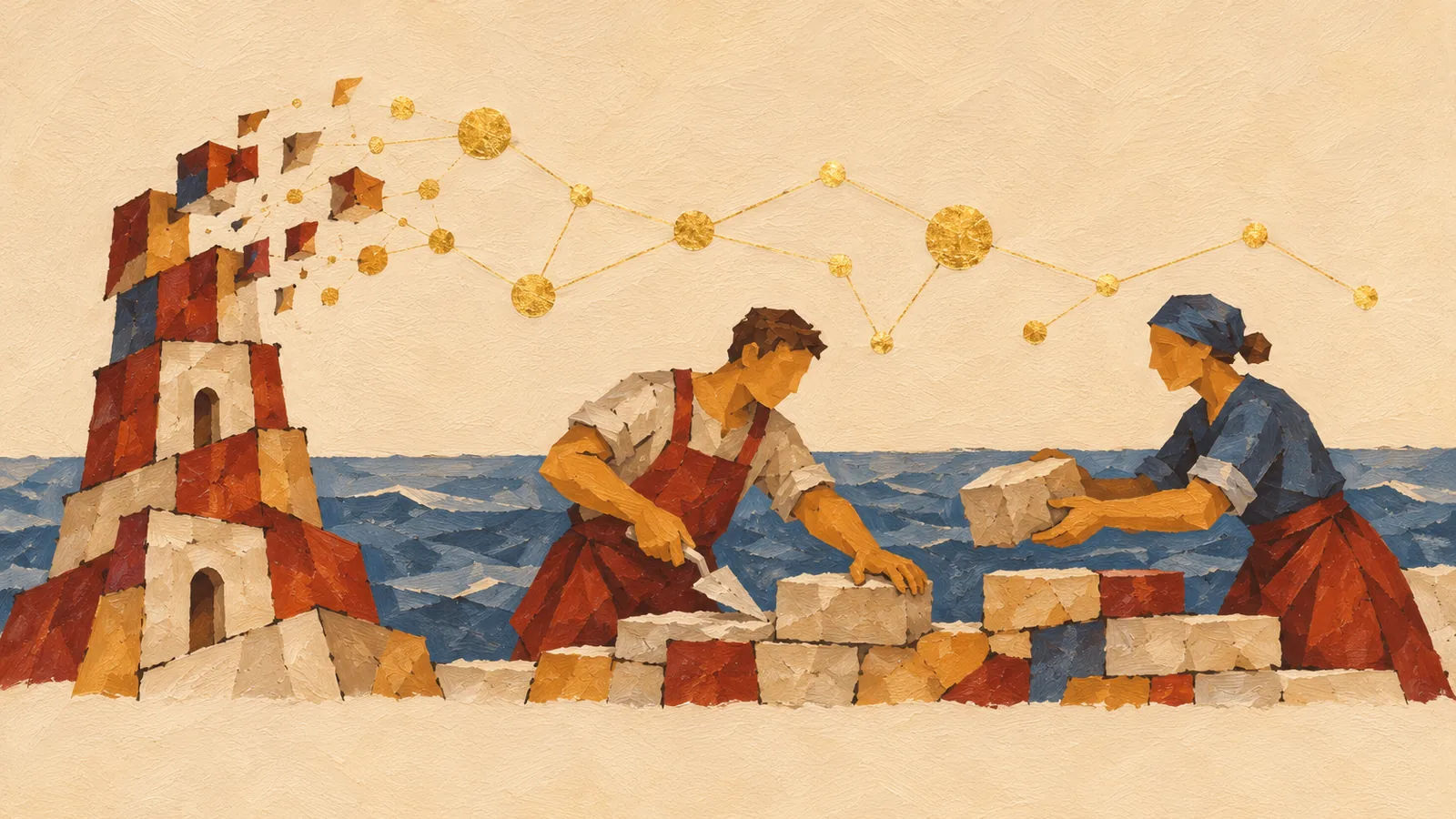
The encyclical opens on an alternative: “either to construct a new Tower of Babel or to build the city in which God and humanity dwell together” (n. 1). It refuses the for or against debate: technology “is never neutral, because it takes on the characteristics of those who devise, finance, regulate and use it”. The primary choice is therefore “not between a ‘yes’ or ‘no’ to technology, but rather between constructing Babel or rebuilding Jerusalem” (n. 9).
Babel is the “Babel syndrome” of “a uniformity that neutralizes differences” and of a language that claims to translate everything, “including the mystery of the person, into data and performance” (n. 10). Nehemiah, on the contrary, returns to a Jerusalem in ruins and “did not impose solutions from above. He convened the families, assigned each of them a section of the wall to rebuild, listened to their concerns, coordinated their efforts” (n. 8). The text turns this into a rule of work: “All are given their own section of the wall: scientists and researchers, entrepreneurs and workers” (n. 13)1.
For a business leader, the image is very concrete. An AI project can aim to make everything uniform and to measure everything, or to give each person a better tool for their own part of the work. These are two different sets of specifications.
What I heard at the Collège des Bernardins in Paris
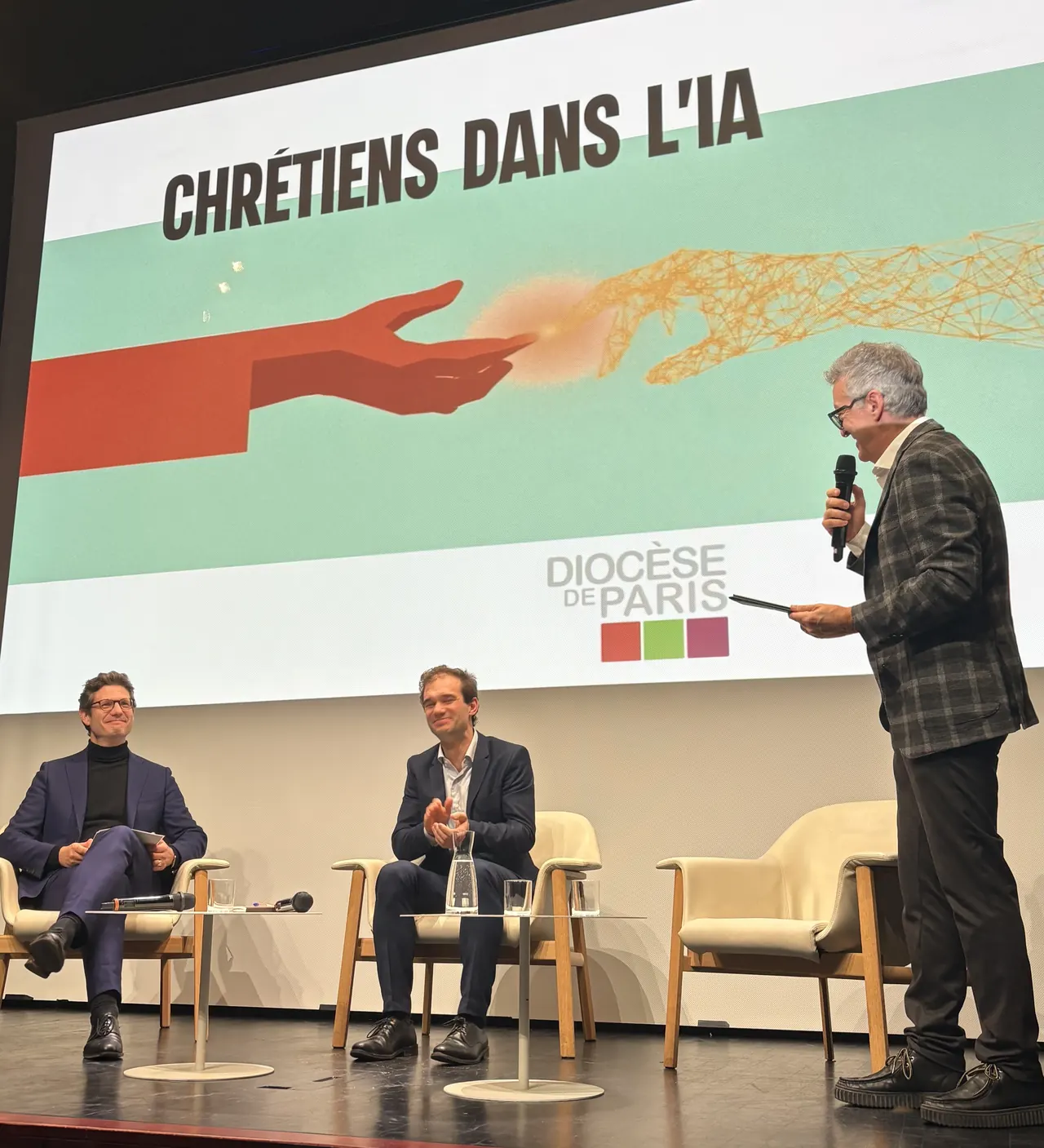
The series “Chrétiens dans l’IA” (Christians in AI), launched by pastor Éric Célérier under the patronage of the Diocese of Paris, held its first evening on 19 November at the Collège des Bernardins3. One of the speakers, Gonzague, is responsible for digital transformation at the LVMH group. His starting point struck me: before deploying anything, his team asked itself one question, “what should the place of AI be? Its right place”.
In a trade where most sales happen in store, face to face, the answer was a principle: “above all not to put AI everywhere, so as not to break that, break that dream and break that place of the human”. Then a question turned around: “where can AI even strengthen human values?” For sales advisers, the goal was not only to be more efficient, “but also to be able to spend more time with each of their clients”.
He described the technical choice this forces. You can build tools that track every move of the salesperson to optimise everything, at the risk of turning them into “an army of robots”. Or the opposite: “are we instead going to develop solutions that allow them to be even more themselves”, and to rely on their own judgement, that “sixth sense” that reads a client the moment they push the door open.
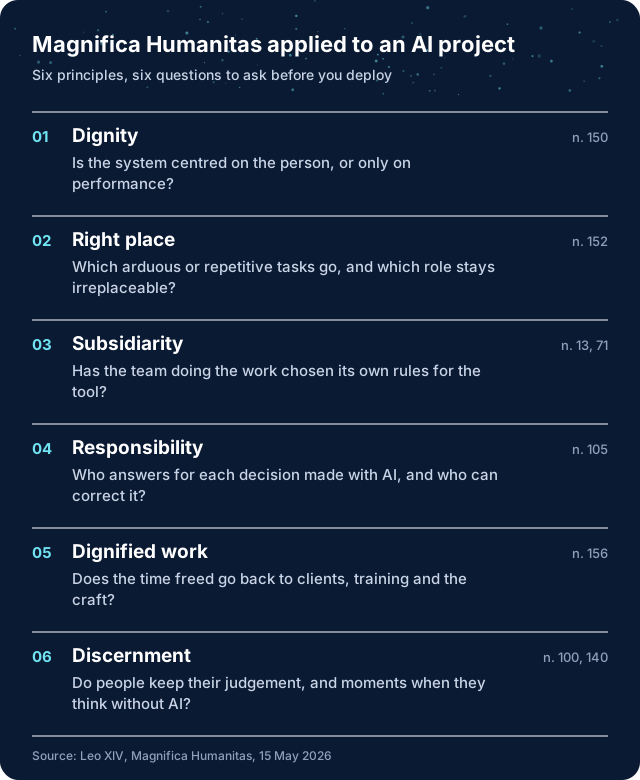
Facing a customer service team whose job is changing, he did not promise a ready-made answer: “I will be there by your side, listening to you, we will experiment together […] and from there we will choose our rules for how we are going to work with AI”. This is exactly the subsidiarity the encyclical speaks of.
Beside him, Augustin Destremau came as a close reader of the encyclical, with an unusual path. He co-founded StaffMe, a platform of short jobs for students. In 2024, these young people asked him so many questions about the future of their jobs since ChatGPT that he handed over the company and spent two years with his family in a spiritual centre in Marseille. During those two years, a speech by Leo XIV three days after his election led him to co-found Rerum Novairum, an initiative of Christian entrepreneurs that offers leaders courses of reflection on AI9. For a few months now he has been running a higher-education school in Marseille, where he lives first-hand what AI changes for its teachers and staff. From the text he kept the call to “exercise restraint in the use of AI” (n. 140), which he puts simply: keeping “moments when we deliberately choose not to use AI”.
Three questions to ask before using AI
Gonzague summed up what he takes from the encyclical in “three fundamental things”, which hold for every use of AI at work:
- Intention. “Am I the one deciding what I want with AI, or do I stay passive?”
- Judgement. “Do I have the right judgement on what is going to come out”, a personal judgement that we keep.
- Responsibility. “Am I ready to take responsibility for what has been produced, even if part of it was done by AI?”
These three questions match two precise passages of the text. The encyclical warns that the ease of getting an answer can “encourage excessive reliance”, and “weaken personal creativity and judgment” (n. 100). And it asks that “responsibility must be clearly defined at every stage”, so that we know who must “account” for decisions and remedy the damage (n. 105)1. Another of his remarks stayed with me: a machine is perfect, a human is not, and “perhaps it is his imperfection that makes his richness”.
What the text asks of businesses
The chapter on work is the most useful for a business leader. It repeats word for word the note Antiqua et nova: while AI promises to take over mundane tasks, “it frequently forces workers to adapt to the speed and demands of machines”, and technology can “deskill workers, subject them to automated surveillance”8. The conclusion is clear: “it is necessary to design systems that are centered on the human person and not solely on performance” (n. 150)1.
The text does not condemn automation. It finds it “desirable” for technology to relieve humans of “arduous, repetitive or dangerous tasks”, while setting a general rule: the protection of employment opportunities and of “the irreplaceable role of the individual” (n. 152). It also proposes a method: “every introduction of automation and AI should be accompanied by verifiable measures to protect the employment, retraining and participation of workers”, so that technology is oriented “toward freeing up human time and capabilities”. And it asks companies to “include quality and dignity of work among its indicators of success” (n. 156)1.
Finally, it applies subsidiarity to the digital world: the large platforms must not impose their rules “from above in an opaque and unilateral manner”, but proceed with “transparency, accountability and meaningful forms of participation” (n. 71). In a small business, this means that the people who do the work have a say on the tool that will change it.
Why Monaco reads this text closely
Monaco is an archdiocese, whose archbishop, Mgr Dominique-Marie David, was appointed on 21 January 202010. But beyond law and institutions, the Principality lives from trades where the relationship creates the value: private banking, wealth management, real estate, hospitality, yachting, luxury retail. These are exactly the trades Gonzague was talking about, the ones where a client wants “a real human” in front of them.
For these businesses, the question is not to automate as much as possible, but to take away from their teams what keeps them from the client: data entry, follow-ups, searching for a document, preparing a file. The time given back must return to the relationship, otherwise AI will only have made the machine run faster.
What PRAGMA takes from it and applies for its clients
We are not theologians, and the encyclical is not a technical manual: the Pope writes himself that “it is not my intention here to offer a comprehensive treatment of artificial intelligence” (n. 97). But its principles match rules we apply on every project, and the evening at the Bernardins confirmed these choices.
- Find the right place before the tool. We start with an audit of tasks together with the team: what wastes time, and what makes the value of the trade and must stay human. A first project covers a single repetitive task.
- AI prepares, a person decides. An agent prepares the reply, the follow-up or the record, and a person on the team reviews and approves it before anything is sent or anything sensitive is changed. Every action is logged.
- A named person in charge. For each automation, one person at the client knows what the tool does, can stop it and answers for what it produces.
- The team chooses its rules. The people who do the work test the prototype on their real data and say what they hand over to the machine and what they keep. This is subsidiarity applied to software.
- Measure the time given back, not only the time saved. We count the hours taken away from repetitive tasks, and we look with the client at where they go: to its clients, its difficult files, its training.
- A tool stays a tool. We do not present an agent as a colleague. Gonzague warned against the idea of managing “AI agents the way you manage your employees”: treating them as persons is, in his words, “an absolutely major mistake”. For us, the agent is a tool serving a person, who stays in control.
This last rule echoes a sentence of the encyclical, on education: “We must learn, then, how to exercise restraint in the use of AI” (n. 140). In a business, this means keeping moments, meetings and decisions where people think without the machine, so as to remain able to judge what it proposes. We look at this loss of autonomy in Is AI making us stupid?
What the encyclical does not say
It is not against progress. It writes that “calling for prudence, rigorous evaluation and even, at times, a slower pace in adopting AI does not mean opposing progress” (n. 106). It recognises that AI can be “a valuable tool” (n. 100). It even calls on Christians not to stay on the sidelines: “Let us not be afraid to get our hands dirty on the ‘construction site’ of our time” (n. 16)1.
Nor does it give a list of ready-to-use rules. As Gonzague put it, it “sends us back to our own responsibilities”. It is up to each business to translate these principles into its choice of tools, and that is the work we do with our clients.
Frequently asked questions
What is Magnifica Humanitas?
It is the first encyclical of Pope Leo XIV, signed in Rome on 15 May 2026. Its full title: encyclical letter “on safeguarding the human person in the time of artificial intelligence”. The official text is published on vatican.va in ten languages.
Is the Church against AI in business?
No. The encyclical sees AI as a valuable tool and finds it desirable that it relieves people of arduous or repetitive work. It asks that systems stay centred on the person, that every decision has a human in charge and that employees take part in the changes.
What does subsidiarity mean in an AI project?
That decisions are taken as close as possible to the people who do the work. In practice, the team concerned tests the tool on its real tasks and sets what it hands over to the machine and what it keeps, instead of having a system designed elsewhere imposed on it.
Do you need to be a believer to apply these principles?
No. The text is addressed to all people of goodwill. Its demands, a human in charge of every decision, employees involved, the quality of work counted as a result, hold for any business.
Why an article on the encyclical on the website of an AI agency in Monaco?
Because the Monegasque Constitution makes the Catholic religion the religion of the State, and the trades of the Principality rest on the relationship with the client. How to bring in AI without damaging that relationship is at the heart of our work.
If you want to know which tasks in your business would gain from being handed to AI, and which must stay human, the free AI audit starts with that question.
Request the free audit and prototype
Sources
- Saint-Siège, Léon XIV, Lettre encyclique Magnifica humanitas sur la protection de la personne humaine à l’ère de l’intelligence artificielle,
- Conseil National de Monaco, Constitution de la Principauté du 17 décembre 1962, article 9,
- Diocèse de Paris, Chrétiens dans l’IA, première soirée au Collège des Bernardins,
- Saint-Siège, Léon XIV, Discours au Collège des cardinaux,
- Saint-Siège, Léon XIII, Lettre encyclique Rerum novarum sur la condition des ouvriers,
- Saint-Siège, François, Message pour la 57e Journée mondiale de la Paix : Intelligence artificielle et paix,
- Saint-Siège, François, Discours à la session du G7 sur l’intelligence artificielle, Borgo Egnazia,
- Dicastère pour la Doctrine de la Foi et Dicastère pour la Culture et l’Éducation, Note Antiqua et nova sur la relation entre l’intelligence artificielle et l’intelligence humaine,
- Acton Institute, Rerum Novairum: first global initiative of Christian entrepreneurs on the AI economic revolution,
- Archidiocèse de Monaco, Monseigneur Dominique-Marie David, Archevêque de Monaco,